
The big idea
Deep work
Professional activities performed in a state of distraction-free concentration that push your cognitive capabilities to their limit. These efforts create new value, improve your skill, and are hard to replicate.
Shallow work
Non-cognitively demanding work that is often performed while distracted. These efforts tend not to create much new value and are easily replicated.
The deep work hypothesis: The ability to perform deep work is becoming increasingly rare, while its value in our economy and the world is increasing. Therefore, the few who cultivate it will be able to thrive.
Chapter 1Deep work is valuable
There are three types of people who will survive technological advancements in our rapidly changing world.
The highly skilled workers
Machines and the rapidly evolving technology around them are becoming increasingly complex. People who are willing to learn and adapt to these advancements will thrive in the future. To get to this stage, Cal argues that you need deep work. Hence the chapter name.
The superstars
With technology making communication throughout the world super easy, those who are the absolute best in their field will thrive. The consumer or business that needs work done can select from a large pool of talent.
Imagine a programmer who lives in a remote village in Italy. If he performs deep work and becomes really good at his craft, he can get hired by companies in America, because communication has become easy and remote work is on the rise.
The owners
Those who have the capital to invest in and own parts of businesses that will impact the future.
Being an owner is difficult because it requires capital, but becoming highly skilled and a superstar in a field is possible.
Two core abilities are needed to thrive in the new economy:
- The ability to quickly master hard things.
- The ability to produce at an elite level, in terms of both speed and quality.
Cal’s argument is that learning hard things requires focusing singularly on the task at hand. That develops your ability to learn complex things. Scattered focus reduces this ability.
The type of work that optimises your performance is deep work. If you’re not comfortable going deep for long periods of time, it will be difficult to get your performance to peak levels of quality and quantity.
Chapter 2Deep work is rare
A lot of companies have open-office cultures where people can be easily distracted. New software tools are also appearing in professional workplaces where, instead of emails, you have instant messaging. This is even worse: your device interrupts you while you’re working, taking away your ability to focus on one task for a long period of time.
The principle of least resistance: In a business setting without clear feedback on the impact of various behaviours, we tend towards behaviours that are easiest in the moment. Things like answering emails quickly.
Richard Feynman, the Nobel Prize-winning physicist, said:
To do real good physics work, you do need absolute solid lengths of time… it needs a lot of concentration… if you have a job administrating anything, you don’t have the time. So I have invented another myth for myself: that I’m irresponsible. I’m actively irresponsible. I tell everyone that I don’t do anything. If anyone asks me to be on a committee for admissions, “no,” I tell them: I’m irresponsible.
Richard Feynman, quoted in Deep Work
Chapter 3Deep work is meaningful
Cal describes the work of a sword craftsman and how he finds his work extremely meaningful. Making swords requires many hours of deep work, and any loss of concentration can put all that effort to waste.
Modern knowledge work can seem like you’re repeating the same things over and over, so finding meaning in depth might be difficult.
You experience life through what you focus on. This is a psychological way of looking at why deep work is meaningful. If your working day is spent answering emails that hold no importance — replying to a scam, answering an admin question, responding to a negative comment — you can start to experience your working life negatively.
On the other hand, if you spend your days doing deep, focused work, your working life can become something you see as meaningful.
The psychologist Mihaly Csikszentmihalyi found that:
The best moments usually occur when a person’s body or mind is stretched to its limits in a voluntary effort to accomplish something difficult and worthwhile.
Mihaly Csikszentmihalyi, quoted in Deep Work
This is what became known as flow.
Ironically, jobs can be easier to enjoy than free time because, like flow activities, they have built-in goals, feedback, rules, and challenges. These encourage you to become involved in your work, concentrate, and lose yourself in it. Free time, on the other hand, is unstructured and requires greater effort to shape into something enjoyable.
Chapter 4Work deeply
Cal describes research into how we fight desires throughout the day. One of the top desires is to stop working hard and concentrating. That’s why it’s so easy to get distracted.
The book presents willpower as a finite resource that gets depleted the more you use it, and something to train like a muscle.
This is why routines and schedules can help. If you’re structured, you need less willpower to take action and start doing deep work.
Mason Currey, a journalist who spent half a decade looking at the habits of famous thinkers and writers, put it this way:
There is a popular notion that artists work from inspiration — that there is some strike or bolt or bubbling up of creative mojo from who knows where…but I hope [my work] makes clear that waiting for inspiration to strike is a terrible, terrible plan. In fact, perhaps the single best piece of advice I can offer to anyone trying to do creative work is to ignore inspiration.
Mason Currey, quoted in Deep Work
How to do deep work
Focus on the wildly important
When you enter a period of deep work, have clear, ambitious goals that are concrete. Saying “I will work for five hours” is not enough. Have clear goals.
Act on the lead measures
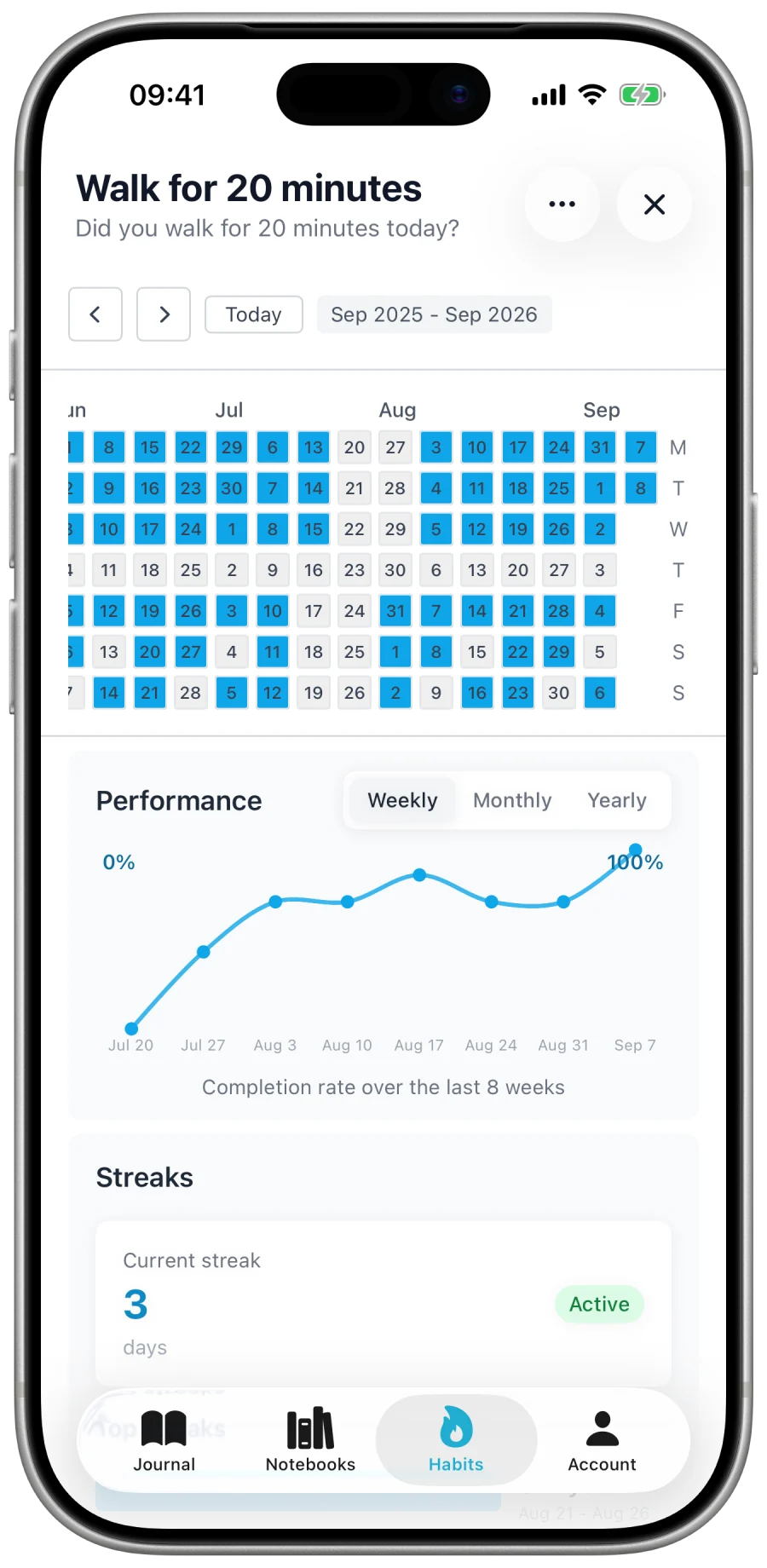
Once you’ve identified your important goals, figure out concrete ways to measure them. Record the time spent in a state of deep work dedicated to your important goal.
Keep a compelling scorecard
“People play differently when they are keeping a score.” Measure how often you’ve been working deeply and for how many hours. Measure how many hours of deep work it takes to reach an important goal.
Keeping scorecards like these can keep you in check and motivated.
Create a cadence of accountability
This can come in the form of a weekly review. Look at your scorecards. How much have you been working, and is it sufficient to reach your important goals? What different strategies do you need if things aren’t working properly?
Walking in nature can help restore concentration.
Have a shutdown ritual. Working or thinking about work in the evenings is not helpful and can reduce productivity. That’s why time off is extremely important, whether it’s spending time with family or walking in nature.
Chapter 5Embrace boredom
Instead of practising not using your phone for one day of the week, flip it around: practise only using your phone one day a week.
That’s extreme. So what you can do is practise using your phone during certain blocks of the day, and never at other times unless it’s absolutely necessary.
Focus is a muscle, and it can be practised.
Learn to meditate productively. This means practising thinking about a problem when your body is occupied doing something physical. For example, think about a complex problem while you’re on a walk.
Improve your attention. Learn to increase your ability to pay attention for a long period of time.
Chapter 6Quit social media
There isn’t much to be said about how bad social media can be for distracting us and pushing us away from our dream life.
A lot of people list a benefit and say, “This is why I need my Facebook account or my Twitter account.” But the benefits they raise can be very small compared with the huge negatives that come with them.
Take the approach of seeing social media as a tool, and different social networks as different tools. Only pick a tool if it meaningfully helps you achieve your dream life. If not, be ruthless in subtraction.
As an experiment, get off social media for 30 days, without announcing it to anyone and without deleting your accounts. Just uninstall the apps.
After 30 days, ask yourself:
- Would my life have been better if I’d had the apps?
- Do I feel left out of important information?
Chances are, the answers to both will be no.
Don’t use the internet to entertain yourself. Put more thought into your leisure time.
Chapter 7Drain the shallows
Schedule every minute of your day. When you first start, you’ll realise that you overestimate how long certain tasks will take. Over time, you get better at this.